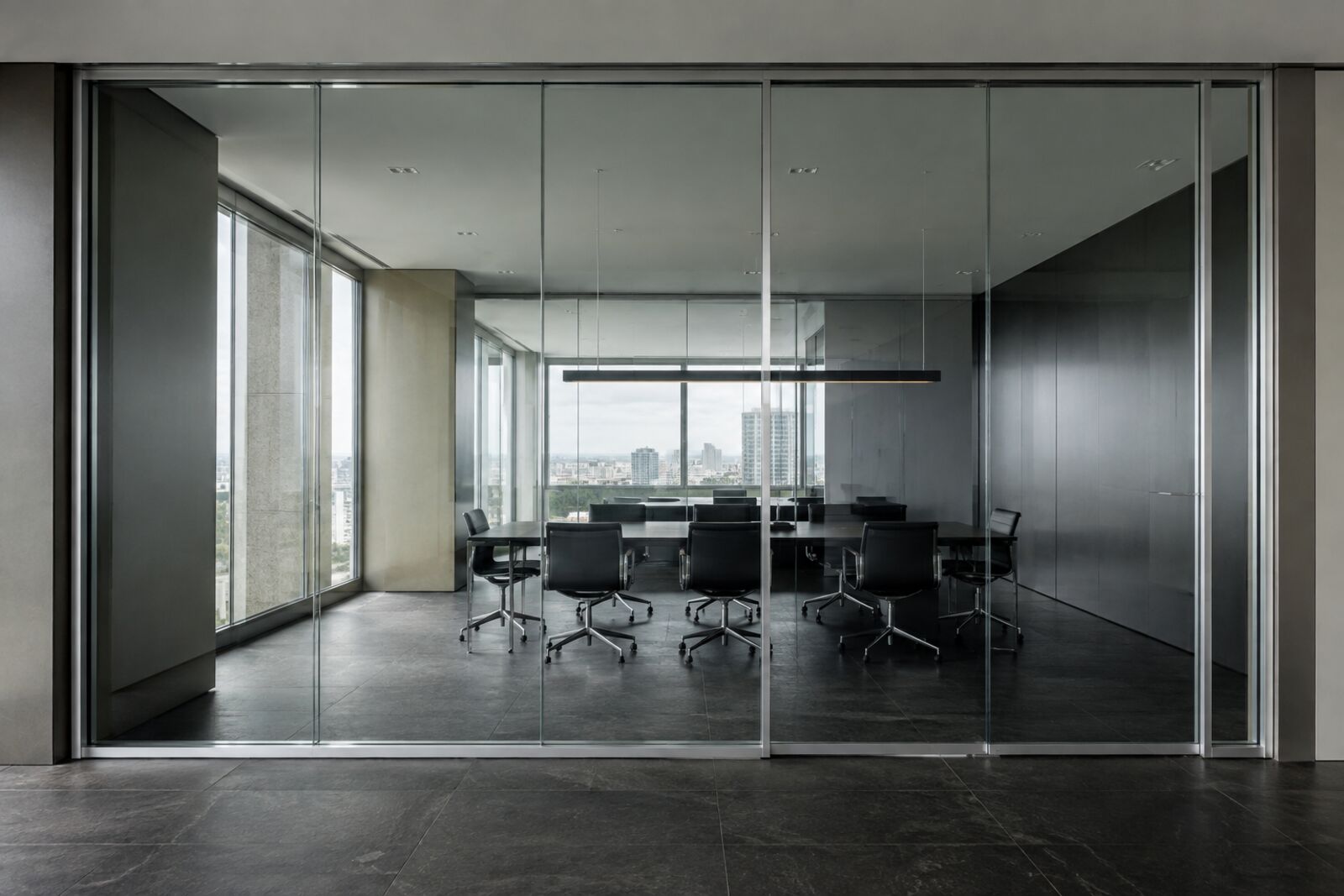
Tempered (Toughened)
Heat-treated so it is several times stronger than ordinary float glass, and breaks into blunt granules rather than shards. It cannot be cut, drilled or notched after toughening, so every hole and cut-out is done first.
Doors & screens
Partitions
Shower screens
Backsplashes
Laminated
Two or more panes bonded to a PVB interlayer. When it breaks, the fragments stay stuck to the interlayer and the pane stays in the opening.
Overhead glazing
Balustrades
Security
Acoustic
Insulated / Double Glazed
Two panes separated by a spacer and a sealed cavity. The cavity is a thermal barrier: that is what keeps heat out. For quiet it is not enough on its own: a partition that actually sounds quiet needs two different glass thicknesses, an acoustic laminated pane and a wide gap, which is why we build office partitions with a 50–100mm cavity rather than a 12mm sealed unit.
Thermal
Street frontage
Solar gain
Low-E (Solar Control)
A microscopically thin metallic coating that reflects solar heat while letting daylight through. In Singapore the number that matters is the solar factor, not the U-value, and the coating sits on the inner face of the outer pane in a sealed unit. Worth it on west elevations and anything taking the afternoon sun.
West elevations
Facades
Afternoon sun
Mirror
Silvered float glass, safety-backed so it holds together if broken. Cut, polished and drilled to the opening.
Wardrobes
Feature walls
Bathrooms
Smart Switchable (PDLC)
A liquid-crystal film laminated between two panes. Powered, the crystals align and the glass is clear; unpowered they scatter and it goes frosted. It still passes daylight, which is the whole advantage over blinds.
Meeting rooms
Clinics
Privacy on demand
Typical thicknesses run 6mm, 8mm, 10mm and 12mm. Which one you need depends on the span, the fixing method and whether the pane is doing any structural work. That comes out of the site measure, not out of a catalogue.